12 Facebook ad examples you wish you made

Written by Brent Barnhart
Published on April 2, 2026
Reading time 9 minutes
Table of Contents
“Want to guarantee engagement? Concerned about your organic reach? Run ads.“
Given their recent algorithm changes, this is the sort of take-it-or-leave-it message Facebook is sending to brands.
Facebook ads are a proven way to get in front of your specific target audience. Pay-to-play is no longer an emerging trend—it’s the expectation.
The brands winning on Facebook right now aren’t debating whether to run ads. They’re debating which ones to run next.
According to the 2026 Sprout Social Content Strategy Report, Facebook is the number one social media platform for product discovery, with nearly 40% of social users turning to it to find new products. 70% of marketing leaders agree it has the strongest business impact of any platform. The question isn’t whether to run Facebook ads but how to make them work.
Where do you begin with your next social media advertising campaign, anyway? It’s easier than you think. We’ve highlighted some of the best Facebook ad examples out there, along with what makes each one tick, to get you started.
Master Facebook ads with help from Sprout Social
Once you’ve gained inspiration from this post, take action.
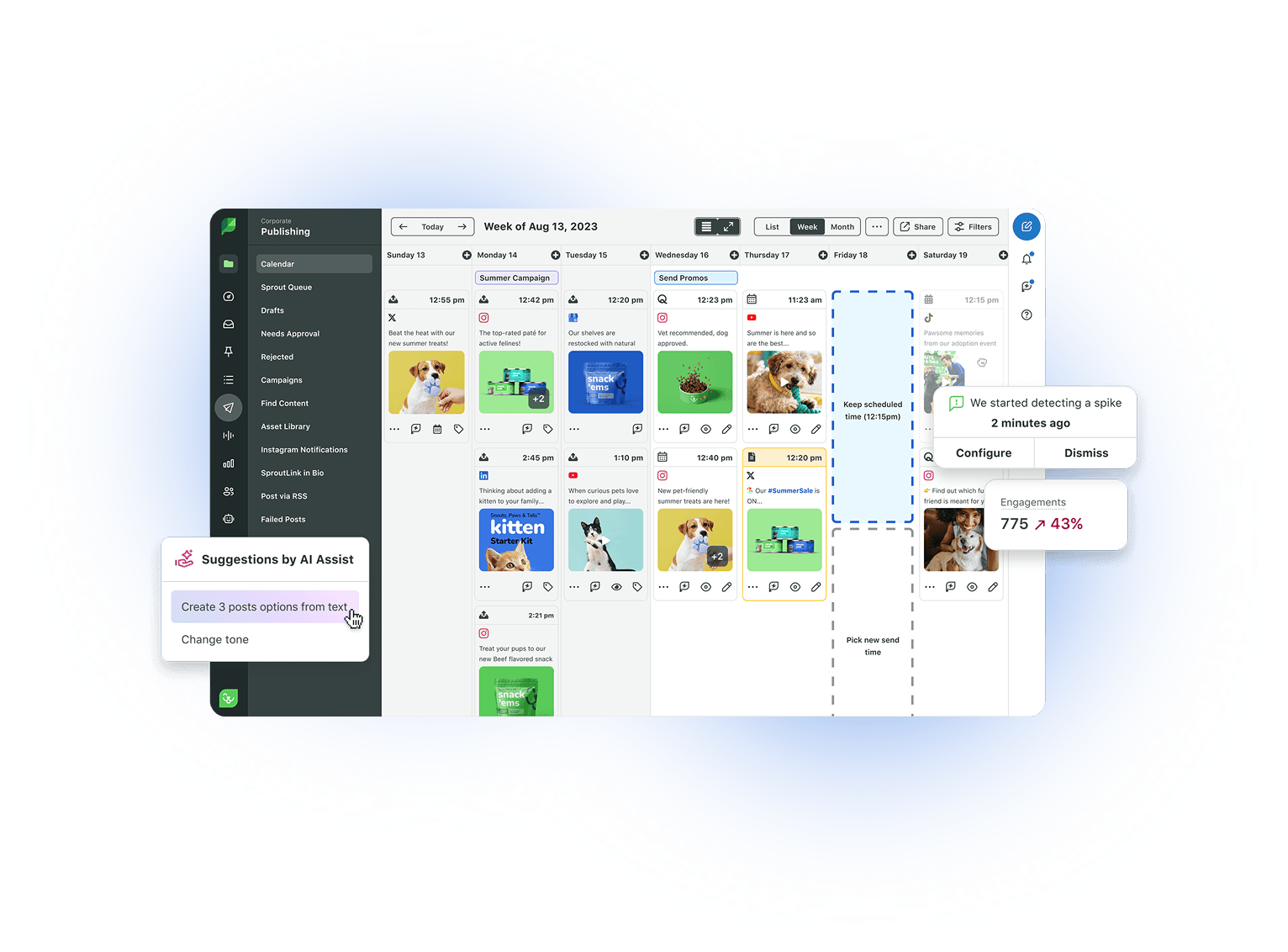
Explore Sprout Social’s Facebook management and reporting tools to connect your creative strategy to measurable results.
Not sure where to start with targeting or campaign setup? Request a free demo today.
The anatomy of a great Facebook ad
A Facebook ad is made up of five core components: a headline that summarizes your offer, primary text that appears above or below your image, a description that adds depth on select ad types, media (your image or video) that captures attention and a call-to-action button that tells viewers exactly what to do next. Every effective ad, regardless of format, brand or budget, is built from these same elements.

The content of each ad is entirely unique to your business. These principles guide your creative decisions every time you build a new campaign.
Keep text tight and concise
The success of your ad lies in its concise wording and delivery. Your headline should immediately capture a viewer’s attention. Tight copy is the name of the game; otherwise, you run the risk of readers tuning out.
Choose your words carefully
Brevity isn’t the be-all, end-all of your ad copy: word choice counts. Given what we know about the psychology behind Facebook ads, advertisers tend to see better results when these five words are included:
-
You
-
Free
-
Because
-
Instantly or now
-
New
Work these words in where they fit the offer naturally. Forced language reads as promotional, while authentic language converts.
Fine-tune your call-to-action
An excellent way to ensure your audience understands the action you want them to take after viewing your Facebook ad is by using a call-to-action button. Depending on your ad objective, you can choose from the following CTAs:
-
Shop Now
-
Book Now
-
Learn More
-
Sign Up
-
Download
“Learn More,” “Shop Now” and “Sign Up” consistently outperform other CTA options. Match your CTA to your objective: “Shop Now” drives direct purchase intent, “Learn More” works for awareness and consideration and “Sign Up” converts for lead generation and event campaigns.
Send audiences to a landing page
If you’re sending people off Facebook, as in the case of a Clicks to Website or Website Conversions objective, direct viewers to a dedicated landing page. The majority of Facebook ads link to a landing page, not a homepage.
Directing your audience to a specific landing page ensures viewers get the most relevant information related to your ad immediately. If sent to your home page instead, it’s up to them to navigate your site and find the details related to the product or service advertised.
This supports your ability to calculate ad performance and ROI and ensures people take the actions you want them to take vs. bouncing.
Facebook ad formats: Which type fits your goal?
Facebook ads work best when the format matches the objective. A strong idea loses momentum fast in the wrong format. Here’s how to match format to goal before you build your next campaign:
|
Ad format |
Best for |
Why it works |
|---|---|---|
|
Image ads |
Direct offers, promotions, limited-time deals |
One message, one visual, one action. No distractions. |
|
Video ads |
Product demos, brand storytelling, awareness |
Motion stops the scroll. According to the 2026 Sprout Social Content Strategy Report, short-form video under 60 seconds drives the highest engagement rates on Facebook. |
|
Carousel ads |
Multi-product showcases, step-by-step stories, feature lists |
Each card is a separate conversion opportunity. More swipes mean more chances to act. |
|
Collection and Instant Experience ads |
Discovery, e-commerce, immersive brand experiences |
Opens a full-screen experience inside Facebook, reducing drop-off between interest and action. |
|
Lead ads |
Contact capture, newsletter signups, demo requests, event registrations |
Pre-filled forms keep people on the platform and remove the friction that kills conversions. |
As you review the examples below, watch for the pattern. The strongest ads don’t just look sharp; they pair the right message with the right format for the right goal.
12 Facebook ad examples you can learn from
The beauty of Facebook ads is how much creative freedom the platform offers. No matter your product or message, you have the creative freedom to craft something that suits your needs.
You don’t need to be a creative genius to make it happen. With inspiration from the following Facebook ad examples, you’ll better understand what makes an ad work. This combination of paid ads and promo posts shows the diversity of Facebook ads and proves many different formulas for engagement are successful.
1. AirAsia
Let’s start by smashing the myth that Facebook ads need to be complicated. This static-image promo from AirAsia screams “simplicity,” but ticks all the boxes of an effective ad.
What makes this ad work? Economical with words, this ad’s copy is direct and effective. The bright imagery is enough to stop scrollers in their tracks, while power words like “FREE” and the limited time offer are both powerful motivators.
2. Sephora
In case you missed it, Facebook explicitly wants brands to produce video content given its high engagement rate. This is exactly why video ads are booming right now, including this Sephora campaign which resulted in a 41% higher click-through rate than their previous ads by packing multiple products and promotions into a few seconds of motion.
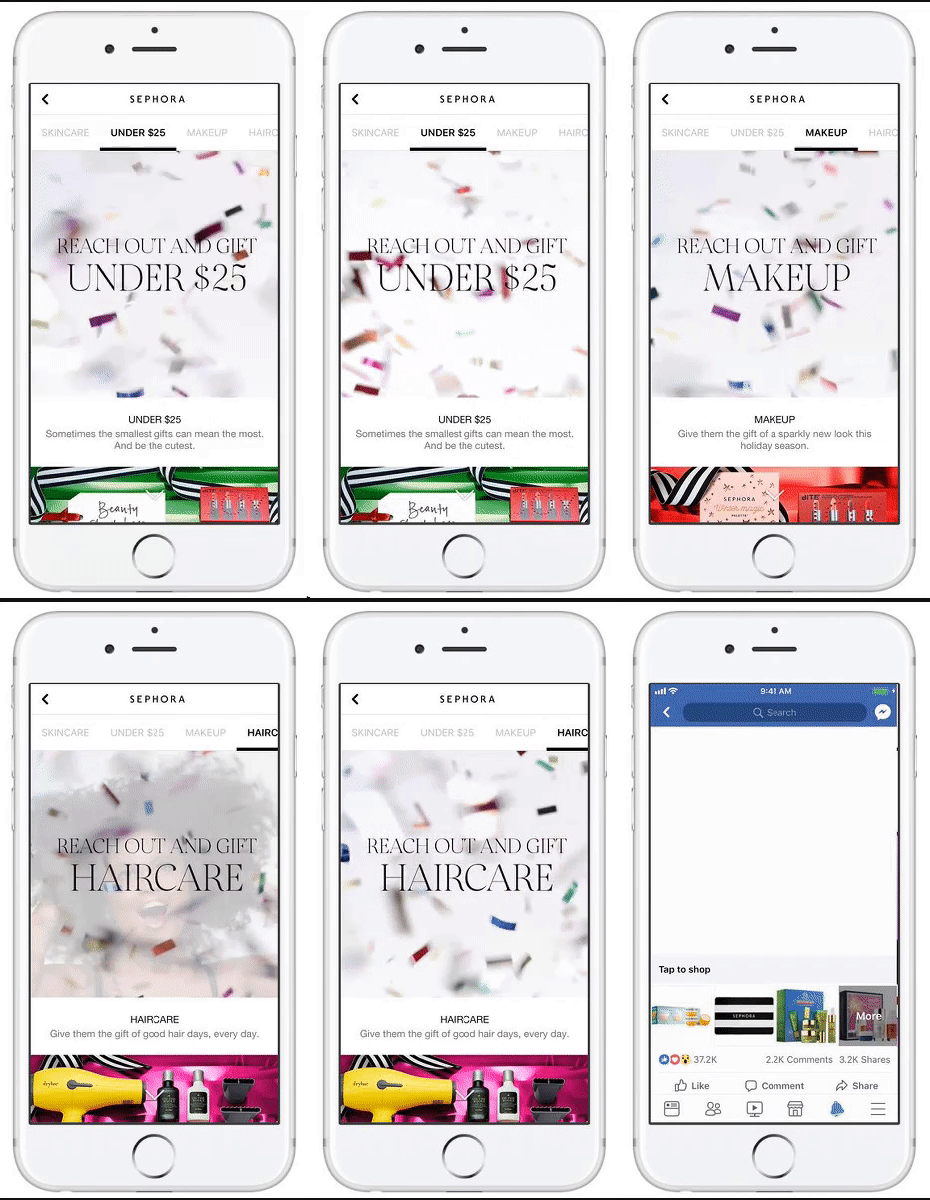
What makes this ad work?There’s a lot going on here visually, which supports the ad’s success in standing out in users’ feeds. The ability to showcase multiple promotions and products via video in a matter of seconds supported the ad in reaching beauty buyers of all shapes and sizes.

3. Project Repat
Great ad creative is possible even with a small budget. While many of these Facebook ad examples come from bigger brands, Project Repat‘s success storyproves the marketing firepower of something as simple as a snapshot.

What makes this ad work?Using a customer as a billboard is a brilliant move given how well user-generated content converts. Less-polished ads work in your brand’s favor given the phenomenon of consumers tuning out traditional marketing messages in their feeds.
4. P.F. Chang’s
A staple of old-school advertising, sweepstakes still work – as proven by P.F. Chang‘s 3x engagement rate to win over entrants. This ad highlights that different ad objectives achieve different results, again signaling the sheer diversity of Facebook’s platform.
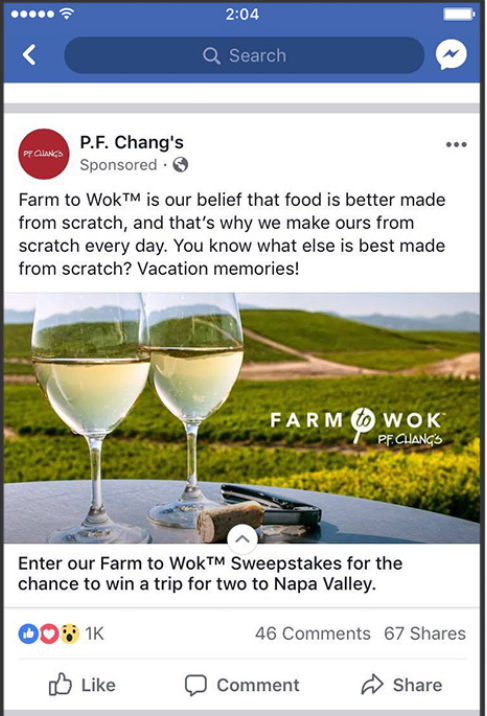
What makes this ad work? Giveaways and contests via social media are still effective, granted you provide a compelling prize for your entrants. This ad’s simple imagery contrasts with its big-ticket prize, making it feel like a sort of hidden gem for entrants.
5. Pura Vida
A shining example of carousel ads in action, this ad proves that Facebook ads are exciting and engaging. The creative, engaging nature of this carousel campaign resulted in Pura Vida selling 20x as many unique products.
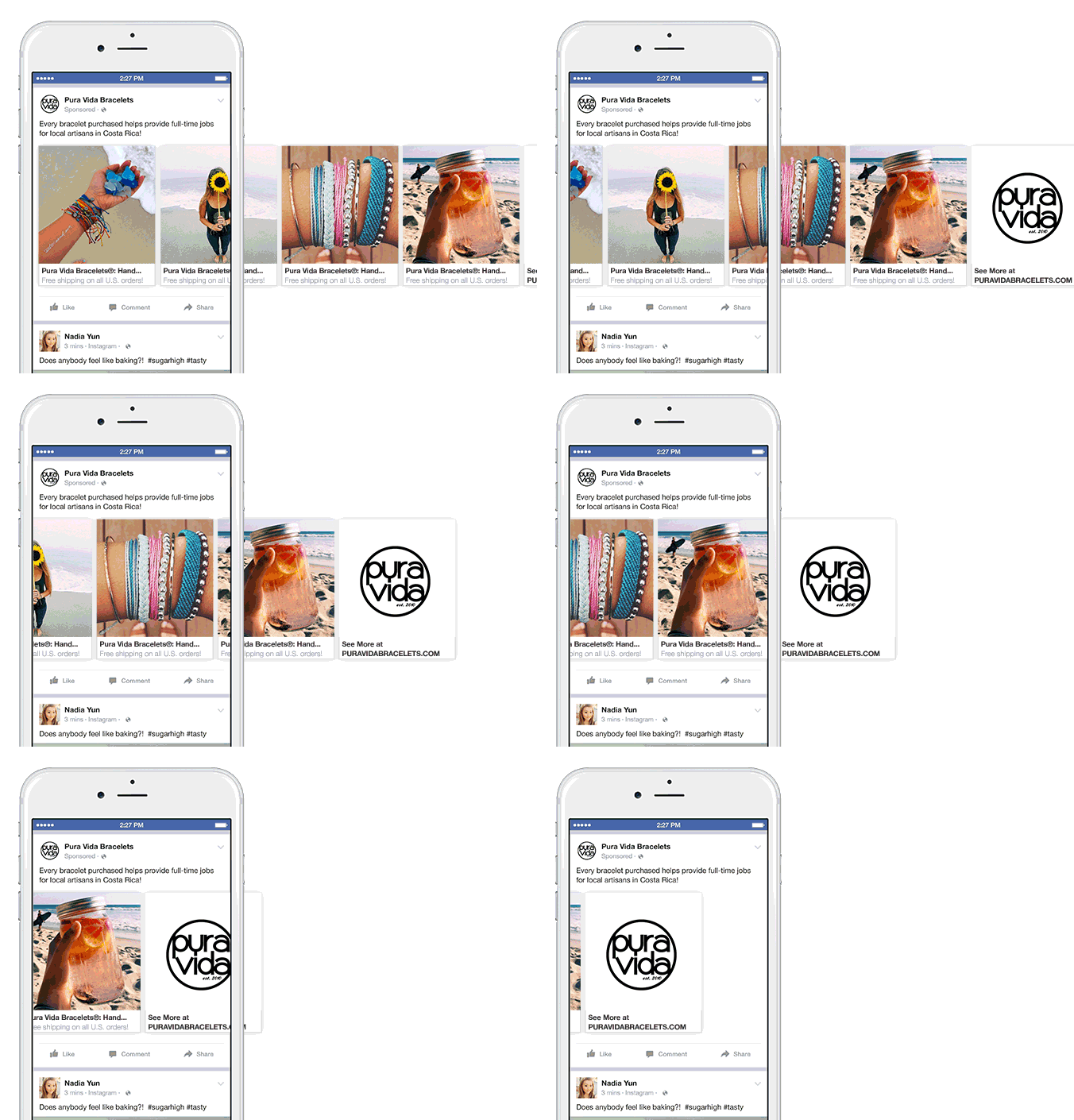
What makes this ad work? The combination of eye-popping imagery, user-generated content and a socially conscious message help this ad deliver. Each slide essentially represents a separate ad in and of itself, allowing plenty of room for experimentation and more opportunities to convert.
6. Porsche
Just when you think you have Facebook’s platform figured out, they throw something new at you. As the most innovative of our Facebook ad examples, this ad implements a carousel including videos and a messenger bot to boot.
What makes this ad work? Everything about this ad is engaging. Want to chat with the Porsche bot? Want to see firsthand accounts of drivers having a blast? Users have plenty of places to click and different ways to experience the ad.
7. Loot Crate
The ultimate goal of any ad is to feel authentic and valuable. Despite the fact that Loot Crate links to their product in just about every single post they make, their promos feel natural and integrated.
What makes this ad work? Asking questions is a smart move in the face of Facebook’s algorithm, which emphasizes engagement. Just look at the number of shares this post scored relative to likes and comments. Discussion-based ad promos are a proven way to get people talking.
8. Dollar Shave Club
Well-known for humorous ad campaigns, this straightforward promo from Dollar Shave Club had exceptional performance. Resulting in an increase of subscribers by 1.5x, this ad shines due to its simplicity.

What makes this ad work? Pun intended, this ad cuts directly to the point. The curiosity-driven copy and competitor call-out was enough to pique users’ interest and drive them to the comments section.
9. TOMS
Unlike many of our Facebook ad examples, this one focuses on more than just dollars and cents. TOMS generated a ton of brand awareness as a result of this canvas ad by focusing on their brand mission instead of their products.

What makes this ad work? By omitting a concrete promo or CTA, the ad makes viewers ask “What’s this all about?” The striking visuals and memorable tagline also work in TOMS’ favor here.
10. MeUndies
Another testament to the power of video, this fast-paced video ad from MeUndies resulted in a whopping 40% increase in conversion rate.

What makes this ad work? The short, humorous tagline sets the tone for this ad, while the rapid-fire video seals the deal. This particular ad is also crafted in a way that appeals to a broad audience, which is a smart touch when you’re scaling reach.
11. Nintendo
Sometimes, a simple approach is the most effective for a Facebook ad. Straight-up sales messages like this one from Nintendo are still effective as long as they’re relevant to your audience.
What makes this ad work? The contrasting, bright colors make this ad visually striking while the time-sensitive offer encourages conversions. Photo content receives relatively high engagement on Facebook, so coupling your offers with a compelling image always helps.
12. HelloFresh
Seeing a pattern with all of the video ads? This HelloFresh ad reminds us that video ads are effective even with simple production.
What makes this ad work? The dual video approach essentially allows for two ads packed into one. Stop-motion represents an easy way to create a video ad minus major production costs, all while showing off your product in the wild.
Facebook lead ad examples
Facebook lead ads eliminate the friction that kills conversions. Instead of sending someone to a landing page and hoping they follow through, lead ads collect contact information inside Facebook, keeping users on the platform.
The strongest lead ads work because they’re built on three non-negotiables:
-
A compelling offer: Demos, free trials, newsletters, event registrations and gated content all perform well. The offer must be worth the form fill.
-
A short form: Every additional field reduces your conversion rate. Ask only for what you actually need. Typically, a name and email address are enough to start the relationship.
-
A matching follow-up: Your confirmation experience must deliver exactly what your ad promised. If you offer a free guide, it arrives immediately. If you promise a callback, that callback happens fast.
Lead ads also demand your sharpest copy. Tell people exactly what they get, why they should want it and what happens next. Vague offers get skipped; specific offers convert.
The same principles that make the examples above work, including tight copy, strong visuals and one obvious CTA, apply directly to your lead ad creative. The format changes. The fundamentals remain the same.
How to measure your Facebook ad performance
Inspiration gets you started. Measurement keeps you in the game.
The best Facebook ad teams don’t just launch creative. They track what happens after the click. Start with these three core metrics:
-
Click-through rate (CTR): Measures how often people click your ad after seeing it. A low CTR signals a creative or targeting problem.
-
Conversion rate: Measures how many clicks turn into desired actions—purchases, signups or downloads. A low conversion rate points to a landing page problem rather than a creative one.
-
Cost per result: Measures how much you spend for each outcome. Track this against your campaign objective to know if your budget is working efficiently.
The real insight comes from comparison. Compare performance by format, audience segment and creative variation. That’s how you move from guessing to knowing which Facebook ad type works best for your brand and which deserves more budget next month.
Sprout Social brings your Facebook ad performance data together alongside your organic content in one place. The Post Performance Report and Tag Report let you compare campaigns, identify patterns and share results in a format your entire team, including leadership, can act on right away.
Once you know what’s working, double down. When you identify underperforming content, cut it fast. Facebook rewards decisiveness.
For more on building a comprehensive Facebook ad strategy, these resources are worth bookmarking: how to build a Facebook advertising strategy, how to master Facebook ad targeting, Facebook Lookalike Audiences and 5 brilliant Facebook campaigns and why they worked.
Ready to connect your Facebook ad strategy to measurable business results? Start a free trial or request a demo to explore Sprout Social’s Facebook analytics and reporting features.
Frequently asked questions about Facebook ads
What should a Facebook ad include?
A Facebook ad includes five core elements: a headline, primary text, a description (on select ad types), media (image or video) and a call-to-action button. Each element has a distinct job. When one is weak, the whole ad underperforms.
Which Facebook ad format works best for conversions?
It depends on your offer and how much context your audience needs: image ads convert well for direct, simple offers; video ads work when your product needs demonstration; and carousel ads perform when multiple benefits or products together make the case for action.
How much should I budget for Facebook ads?
Start with enough budget to generate meaningful data across at least two or three creative and audience variations; the exact amount depends on your goal, audience size and testing needs.
How do I know if my Facebook ads are working?
Track click-through rate, conversion rate and cost per result. If the right people are taking the right action at a cost that supports your goals, your ads are working. Use Sprout Social’s reporting tools to consolidate your data and compare campaign performance in one place.

Share